THURS 30 APRIL 2026 …
"As we stepped outside after our tasting Cyrielle pointed across the street to the hillside where the ‘Clos St. Jacques’ lay. ... She told me that the Clos St. Jacques has 4 different bedrocks almost creating four perfect squares or blocks in the vineyard. So, naturally as an American winemaker who is used to farming clonal blocks of vineyards and harvesting them all separately and fermenting them all separately, I asked if she did the same. She simply said: “Why would we do that? This is the Clos St. Jacques. Inside these vineyard walls is one organism, like a village. One vineyard but made up of thousands of different vines. Some old, some young, some overripe, some underripe, some perfect, but together they make the wine great. They make the wine complex and whole.”
And although part of me found that answer to be very French, I could not agree more and I left Gevrey Chambertin that day with a different perspective on farming and winemaking."
Josh Bergstrom of Bergstrom Wines, Oregon, in conversation with Cyrielle Rousseau, great-grand-daughter of Armand Rousseau, and fourth-generation wine-maker.
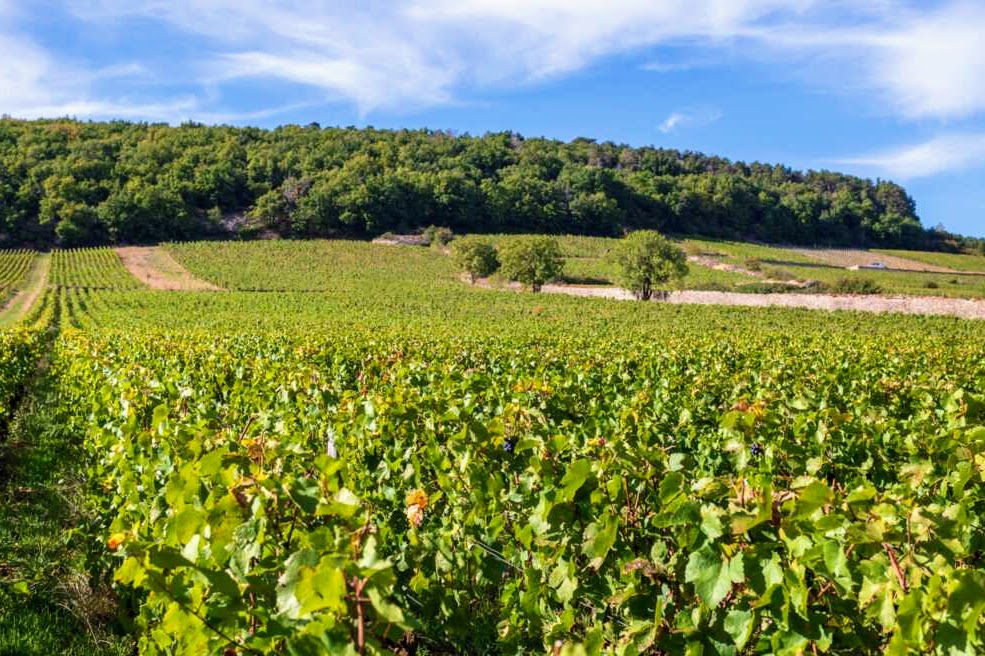
"The upper part of Clos Saint-Jacques Premier Cru vineyard, in Gevrey-Chambertin. It is a largely walled vineyard of 6.7 ha, gently sloping to the SE, with woodland above. It is flanked by Les Cazetiers to the NE, and Lavaux Saint-Jacques to the SW. Altitudinal range is from 290 to 340 metres, with an average slope of 17° ... somewhat greater at the top than the bottom. The vine rows run up and down the slope, in all 5 parcels. Owners since 1954 are Domaine A. Rousseau, Domaine Fourrier, Domaine Clair-Dau, and Domaine Sylvie Esmonin. In 1985 the Clair-Dau holding was split in two, and Domaine Louis Jadot became the fifth owner.
Photo credit: https://www.beckywasserman.com
Background:
The Wellington district as a whole, including the Wairarapa wine-makers, is fortunate in that among some long-experienced wine-people there are several very skilled pinot noir tasters in Wellington city, whose reference horizons embrace Burgundy rather more than New Zealand. Howard Davis is one of them. He has travelled to Burgundy a number of times, with the goal of visiting leading winemakers, these visits often facilitated by introductions from discriminating New Zealand wine importers. On the last day of April this year, Howard presented an intriguing tasting based on the wines of the famous Gevrey-Chambertin vineyard Clos Saint-Jacques. The nine wines were all from the somewhat lesser year 2007, but that had the advantage that their historical price was relatively lower ... compared with the now often out-of-reach prices for more recent Burgundy vintages. The tasting was hosted by Regional Wines & Spirits Wellington, who have a long history of supporting detailed and reflective wine tastings which illuminate earlier vintages … both in New Zealand, and overseas. The tasting filled quickly, and attracted winemakers from the Wairarapa, as well as local wine enthusiasts.
In introducing the tasting, Howard drew attention to the unusual qualities of the Clos Saint-Jacques vineyard, whereby it is owned by only five winemakers, and each holds a near-identical strip aligned parallel through the full slope of the vineyard. The whole vineyard faces approximately south-east, and being on a slope reduces frost risk. Drainage is good virtually throughout. The vineyard has long been considered a candidate for promotion to Grand Cru status, but there appears to be a working agreement among the five owners that they would prefer to be pre-eminent among the Premier Cru sites, rather than competing with the admittedly world-famous Grands Crus of Gevrey-Chambertin.
Howard further outlined that one of his goals for the tasting, given the closely matching site conditions for the five different owners, was to evaluate to what extent the differing wine-making techniques for each proprietor shaped their wine, in the same vintage. This is more easily asked than achieved, on the opposite side of the world, where by and large few New Zealanders can any longer afford classed burgundy. Accordingly I have attempted to retrieve and document some of these winemaking details in this review of the wines. But this task too is not easily achieved, so many French proprietors preferring to talk about the romance of their wines and winery, rather than the day-to-day facts.
The 2007 Vintage in Burgundy:
Wine Spectator rating for the 2007 vintage: 90 “Meticulous sorting produced very good grapes; fruity, vivid, elegant reds for early to mid-term drinking. Good success in Gevrey-Chambertin.”
Jancis Robinson Vintage Chart: “A dank summer led to rotten Pinot Noir grapes and the need for extremely strict selection. The vintage is unlikely to notch up record scores.” No scores
Farr Vintners Vintage Chart: “A charming vintage for current drinking. Underrated with wines that offer great drinking pleasure now, but which are not for long-term ageing.” No scores
Robert Parker Vintage Chart: 91 “Cote de Nuits red: Outstanding. Early maturing and accessible,”
Wine Enthusiast Vintage Chart: Côte de Nuits (red), 88
Wine Scholar Guild Vintage Chart (Andrew Jefford), **½ “Drink / Past Peak. Early flowering; cold, wet summer. Threat of mildew & rot. Early harvest. Severe sorting often reduced volume. Best in Cote de Nuits (Gevrey, Vosne, Nuits).”
Note on geology and soils in the Clos Saint-Jacques vineyard:
With its 80 ha of Grands Crus vineyards, and some compelling Premiers Crus as well, Gevrey-Chambertin is famous for producing some of the most sought-after wines in Burgundy. Jasper Morris, author of the standard reference text Inside Burgundy, sums up the attributes of Clos Saint-Jacques wine thus: “The soil changes from white marl at the top to browner clays at the bottom, with many small stones throughout. The combination of this triple soil type and the perfect exposure to the south and east explains why Clos St-Jacques can be such a complete wine. It has structure, weight, and certainly complexity."
In a little more detail, the Clos Saint-Jacques vineyard contains rock-types and soil features much envied (and desired) in the New World. Above, there are shelly Jurassic limestones and shallow stony soils. In the mid-slopes there are similarly-aged softer limestones with other invertebrate fossils, plus limestone debris from above. Below are deeper clay-rich brown soils on hard limestones, in places with alluvial cobbles. All soils are profoundly influenced by the calcareous soil parent materials contributing to them, and combined with the slope, are generally well-drained.
Layout of the five Clos Saint-Jacques vineyards:
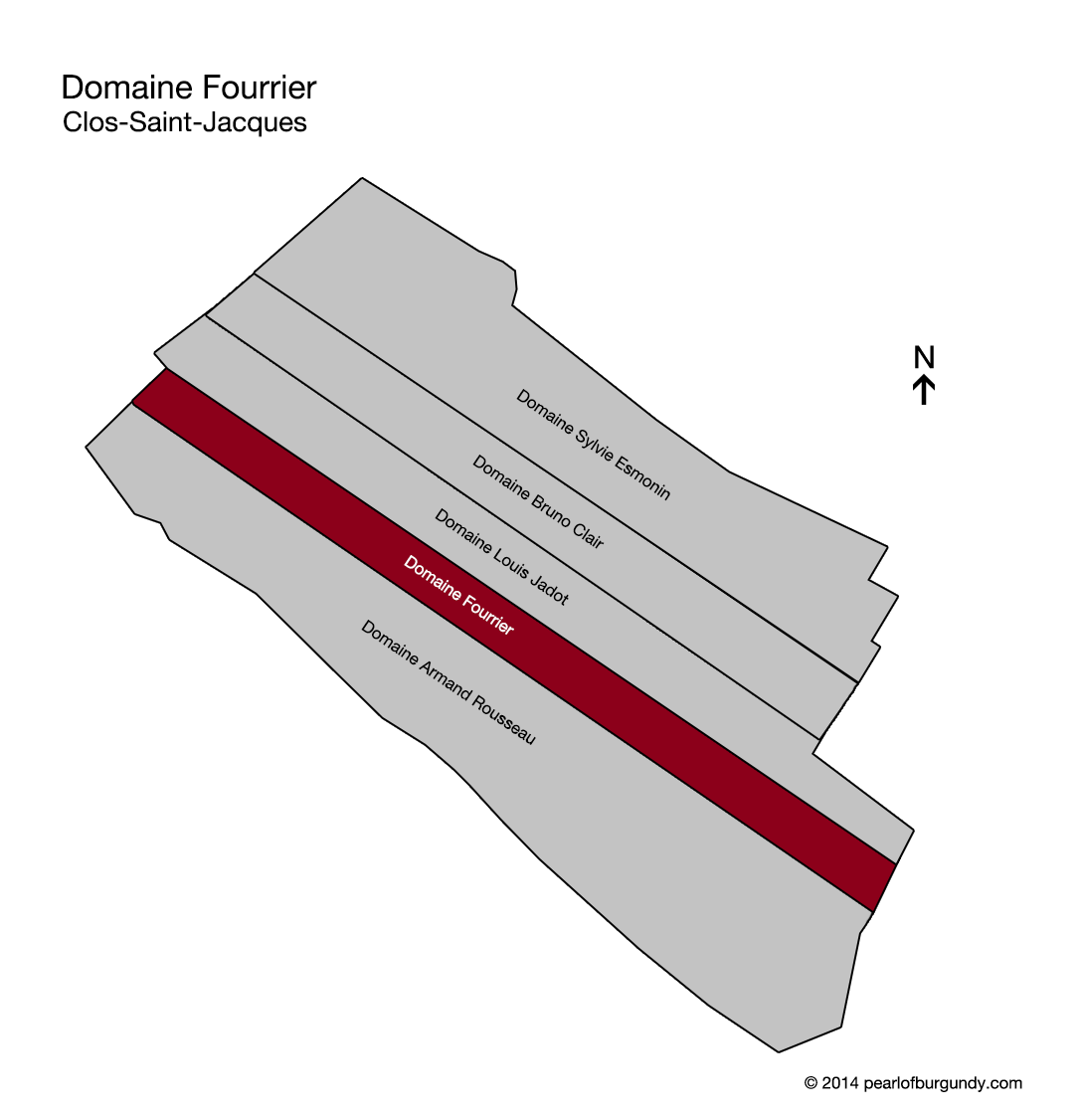
The five holdings in the 6.7 ha Clos Saint-Jacques, each with closely similar site and soil conditions. Areas are: Armand Rousseau: 2.21 hectares; Sylvie Esmonin: 1.60 hectares; Louis Jadot: 1.00 hectare; Bruno Clair: 1.00 hectare; Fourrier family: 0.89 hectares.
Photo credit: https://www.pearlofburgundy.com
Acknowledgements:
Bruce Taylor, winemaker at Tohu, Andrew Moore, and John Shearlock all contributed to this review.
References:
Johnson, Hugh & Jancis Robinson, 2001: The World Atlas of Wine, Fifth Edition. Mitchell Beazley, London, 352 p.
Morris, Jasper MW, 2010: Inside Burgundy. Berry Bros & Rudd, 656 p.
https://bergstromwines.com/return-to-burgundy-part-1/? = an Oregon winery specialising in pinot noir
www.farrvintners.com = leading London wine merchant, good source for reviews.
www.jancisrobinson.com = Jancis Robinson MW and Julia Harding MW, plus now associates, some free articles, subscription needed for reviews.
https://www.klwines.com = K&L Wine Merchants, founded in California. This site is by far the best source of wine review information available (beyond personal subscription), but it is simplest to let the Net search their site, the site’s Search function being less adept.
https://louisdressner.com/articles/sylvie-esmonin-interview = a New York wine importer concentrating on artisan wineries.
https://www.robertparker.com = Robert Parker and successors, vintage chart, subscription needed for reviews.
https://www.wineenthusiast.com/wine-vintage-chart = an alternative American wine review site,
https://www.winescholarguild.com/vintage-charts/french-wine-vintage-chart/bourgogne-vintage-chart = careful assessments by Andrew Jefford for the Wine Scholar organisation, which is US-based, but Europe-focussed.
https://www.wine-searcher.com = free access to basic functions. Need to click 'Shop Location: All countries' to get realistic valuations for New Zealand.
www.winespectator.com = Wine Spectator magazine and website. The most complete vintage charts available, subscription needed for reviews.
The Net generally ... open-ended questions such as: 'review 2007 Sylvie Esmonin Clos Saint-Jacques' will often provide free-access single reviews from sites beyond one's own immediate subscription list. As always, discrimination needed.
THE WINES REVIEWED:
For the wine reviews in this article, the first price given in the format is the estimated original release price, in New Zealand dollars. The second price in the italicised initial part of the review is the current 2026 Wine-Searcher valuation. Note their values can change appreciably from one day to the next.

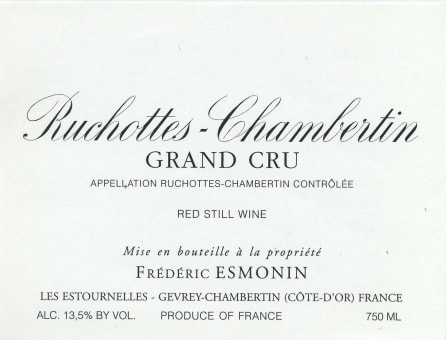
Good ruby and garnet, still some red, just below midway in depth. Right from the outset, this is one of the more fragrant wines, with a sense of ripe fruit. But the bouquet is also quiet, needing close attention, showing dusky florals in a deep red roses spectrum, suggesting black as well as red fruits. In addition there are subtle aromatics hinting at piquancy, which so often lift the best Cote de Nuits wines above those of the Cote de Beaune, even though the alcohol is relatively low. The sense of ripeness carries through to the palate, again both red and darker cherry fruit notes, and more richness and ripeness than most in the tasting. Oak is sweet and fragrant, and combined with the fruit and lovely acid balance, lengthens the palate beautifully. With Burgundy Grand Cru wines now so rarely imported into New Zealand, and even less frequently offered at retail, this is the kind of ‘real’ pinot noir that both wine lovers and winemakers see much less frequently than is needed, if we are to achieve wines of burgundian dry extract as well as finesse in New Zealand. Even so this is not quite take-your-breath-away wine, just a lovely example of red burgundy, at full maturity, but no hurry. For the tasting group, it was rated top equal in the four sighter wines Howard presented, before the set of Clos Saint-Jacques. GK 05/26
Ruby and garnet, much redder than most, the second deepest. This wine stood out in the tasting for its depth of bouquet, and much greater apparent fruit ripeness, to the point of it showing less noticeable florals but more black cherry and dark plum qualities. Fruit seems dominant over oak on bouquet, giving the impression of a quite big wine to follow. But that was not quite the case, the fruit not as rich as expected or hoped, with the oak now showing relatively more than on bouquet, plus a hint of acid noticeable. It makes an intriguing comparison with the all-red-fruits Faiveley. The two wines between them illustrate much of the magic of the Cote de Nuits. This is much the youngest wine in the set, cellar another 10 – 12 years. GK 05/26
Ruby and garnet, quite a lot of garnet, the third to lightest wine. Volume of bouquet is the high point of this wine, noticeably lighter and fresher than the Ruchottes-Chambertin, though freshly-poured a few tasters wondered if this wine showed some old oak in its elevation. That doubt dispelled with air. Again the bouquet has that excitement of the Cote de Nuits, even though it is a little 'cool' relative to the top two wines. That thought carries through to palate, where red fruits dominate, and the acid balance is slightly fresher. But all in all, this too is attractive burgundy, merely reflecting its vintage. Fully mature – if held, the acid may become more apparent. For the group, this was the other wine rated top equal among the four sighter wines. GK 05/26
Ruby and garnet, still some red, just above midway in depth, an archetypal fine burgundy colour. In one sense this is the most burgundian of all the wines, the wonderful florality and purity of its bouquet being striking, with exquisite and subtle oak. Floral analogies include roses, but a much lighter red hue than the Frederic Esmonin, with even perhaps salmon hues. As with most of the wines, the weakness of the vintage prevents the beautiful bouquet expanding on palate: instead it is all red fruits, just a little too acid, and showing trace leaf – if you think about it. But the palate is still a delight. This was the second favourite of the Clos Saint-Jacques wines for the group. Fully mature. GK 05/26
Ruby and garnet, in the middle for depth. This wine is explicitly floral and varietal, but with some traces of coolness in the bouquet. Mostly red berries are matched by very pure and fragrant oak. Initial palate gives a refreshing suggestion of red and even perhaps black cherry fruit shaped by this lovely oak, but then the trace of leafyness shortens the fruit flavour and apparent ripeness appreciably, relative to the Jadot. It shows better acid balance than the Rousseau, but is again a wine of its year. A tending lighter but pretty wine, ranking second-favourite among the five Clos Saint-Jacques wines. Fully mature, the acid becoming noticeable. GK 05/26
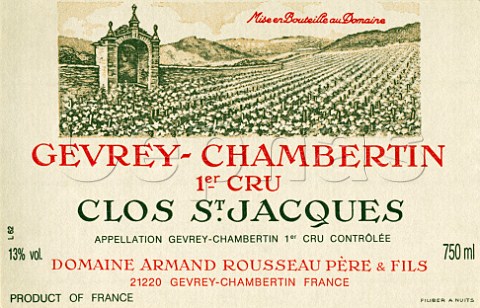
Garnet and ruby, one of the older, and the lightest. Like the Jadot, this wine is characterised by its exquisite purity, and an all-red-fruits bouquet showing a little more oak than the Jadot. Here again the rose analogies suggest much lighter shades of red, but all sweet and lovely. Palate however is much shorter than the Jadot, with both oak and acid more to the fore. When reviewing this wine in 2010, I expressed the hope it would fill out in bottle, given the release price (in New Zealand) of $NZ377, and marked it 17+. As is often the case with wines showing more apparent (and beautiful) oak, the group as a whole marked this the top wine of the five Clos Saint-Jacques. The ‘public’ tasting was not blind, and the Rousseau was placed last … both factors conducive to the wine being marked highly. Fully mature. The present Wine-Searcher valuation is now $NZ2,645, reflecting that now Domaine Rousseau is in general so highly regarded, checking with reality for any given wine is not always undertaken. GK 05/26
[ This wine not in the ‘public’ tasting, added to the second blind tasting only.] Garnet and ruby, the second to lightest wine, but even so, a remarkable match in hue, depth and style for most of the burgundies. In the blind tasting, there was no hint on bouquet that this wine was not one of the burgundies. It was not as floral as some, but the ripeness indicated both red and black cherry analogies. It did differ in this set by being less floral, but also in having an extra dimension best described as subtly umami / brown portobello mushroom – totally appropriate for complex pinot noir … and not brett. Palate showed greater fruit than many, and a ripeness level comparable with the Ruchottes-Chambertin, but lacking some of that wine’s florality and magic. The quality of fruit, and the acid balance on palate are quite remarkable, considering the very different price level at release. The winery confirms the nil fermentable sugar. This Tohu wine in maturity suggests the Awatere Valley shows considerable potential for producing fine and world-class pinot noir … a possibility not much proclaimed, thus far. Mature, but no great hurry. GK 05/26
Garnet and ruby, marginally the deepest wine alongside the Bachelet … but older, at the blind stage. At the group tasting, this wine presented reluctantly, still some bouquet but no florals, more brown tobacco in a very firm way … some links with the Tohu. In mouth the oak initially dominated, supported by darker fruits, even black cherry. Overnight it breathed up appreciably, the dark oak quality now supported by quite ripe black fruits, but then curiously, some acid appearing in the finish. Quite apart from the colour, this is one of the younger wines in the set, which will cellar for 10 or so more years, and perhaps harmonise desirably. GK 05/26
Ruby and garnet, the third deepest wine, and still good redness. Bouquet is dusky and darkly floral, even a fleeting hint of violets, on red and black fruits including black cherries, plus good oak. The promise on bouquet curiously does not carry through to the palate, the fruit lacking juiciness and suppleness, with a clear suggestion of stalky short flavours, and acid creeping up. The oak serves to smooth out these mixed impressions remarkably well, but the overall impression is lesser. Unusual wine, in a burgundy sense, such that I wondered at the blind stage if it was one of my interlopers. Would probably appeal more with the right food. Fully mature, judging by the acid balance. GK 05/26
Ruby and garnet, still quite red. Bouquet is quite different from the field, being comparatively stalky, lacking fruit ripeness, and more alcoholic. These impressions are exacerbated by excess oak. Despite attractive purity, there is simply a lack of ripe fruit on bouquet. Palate conflicts to a degree, showing good red fruit flavours, and clear pinot noir varietal character, but all let down by under-ripeness and very stalky notes, intrusive acid, and oak. It does seem to have the body to develop a little more in bottle. Worth recalling that 2007 was relatively early days for Central Otago wine-making … compared with lately. I have reviewed this wine three times in its youth, two favourably, one more like this bottle. I cannot account for the differences recorded – it is as if the wine was not assembled pre-bottling. GK 05/26
© Geoff Kelly. By using this site you agree to the Terms of Use. Please advise me of errors.