Background to, and Conclusions from, the 2005 red burgundy Library Tasting:
In August 2026 I offered a Library Tasting review of the 2005 red burgundies to pinotphiles in the Wellington district. The range of wines offered in the 12 examples ranged from Village wines through Premiers Crus, to four Grands Crus. The latter were distinguished by showing three different growers' versions of the famed Grand Cru Clos de la Roche, in Morey-Saint-Denis. It is likely such a comparison at the Grand Cru level, and in such a well-regarded year, has not been offered in a semi-public tasting in New Zealand for some years. Grand Cru red burgundy is now scarce at retail in New Zealand. And there was one well-regarded 2005 New Zealand pinot noir … as always … to check where we stood 20 years ago.
Upon advertising availability on the Regional Wines & Spirits website, this tasting found favour with both Wellington’s committed pinot noir wine community, and with the keenest Martinborough pinot noir winemakers, plus the proprietor of a well-regarded Marlborough smaller winery, and a winemaker also practising in Otago. These knowledgeable people added greatly to the tenor of the discussion in this tasting, and made the evening memorable. With the wines now having a considerable value on the very active New Zealand secondary (wine-auction) market, the fee for the tasting had to be set at $290, yet it sold out within 2 hours.
I have offered two previous reviews of the 2005 red burgundies, though at not quite such a noteworthy wine-level as this one. The first was for Otago winemakers, at Cromwell, in 2015; the second for Marlborough and Nelson winemakers, at the Nelson & Marlborough Institute of Technology, Blenheim, in 2016. Both are written up on this website, with Introductions to the vintage in Burgundy. In both those tastings, the wines seemed youthful, good fruit but the structure tending tanniny, not yet revealing much of themselves. The question in 2026, at the 21-year-point was, would these wines have started to unfold, and reveal more of their bouquet, and the tender / supple and fragrant side of red burgundy.
And following this 2026 tasting, our conclusions (from again a very small sample) build on Robinson, 2015: that the 2005 burgundies are now either ready in the Cote de Beaune, or maybe some of the smaller even declining, whereas in the Cote de Nuits carefully-selected Village wines are now opening up tantalisingly, revealing delightful qualities of aroma and taste. The classed growths likewise are now a good deal more forthcoming, and either nearly ready, or a good deal closer to full development (depending on the rank of the vineyard). The tannins are softening, the fruit is more apparent, and some wines are clearly fragrant, but rarely floral. And the best wines in the Cote de Nuits may still have 20 years ahead of them. The continued appeal of the 2005 vintage in Burgundy seems assured.
We did wonder however how many wines in this clearly very ripe year would ever display the alluring floral complexity and charm that characterised an earlier generation of fine burgundies. This very real issue of a warmer Burgundy making more popular (ie fruity) but arguably less complex wines clearly offers exciting possibilities … including outside Burgundy. Might other countries with a greater geographic range of sites to explore rediscover the earlier delights of a subtler and slightly less ripe style of pinot noir ? In New Zealand, local districts such as the now marginally cold Waitaki Valley, which includes calcareous soil parent materials, might be an example ? Or the limestone-influenced soils in or near the Awatere Valley, Marlborough.
In the tasting notes section following the introductory matter, the wines are listed in rank order. Some of the factors considered in ranking the wines are given there. A summary of those views is given in the caption to the illustration below showing the top six wines. While for true wine enthusiasts there is always a measure of sadness in the top wine being so clearly also the most expensive, on this occasion there was simply no doubt about the varietal quality, and wine subtlety and finesse, of the Rousseau, as top wine.
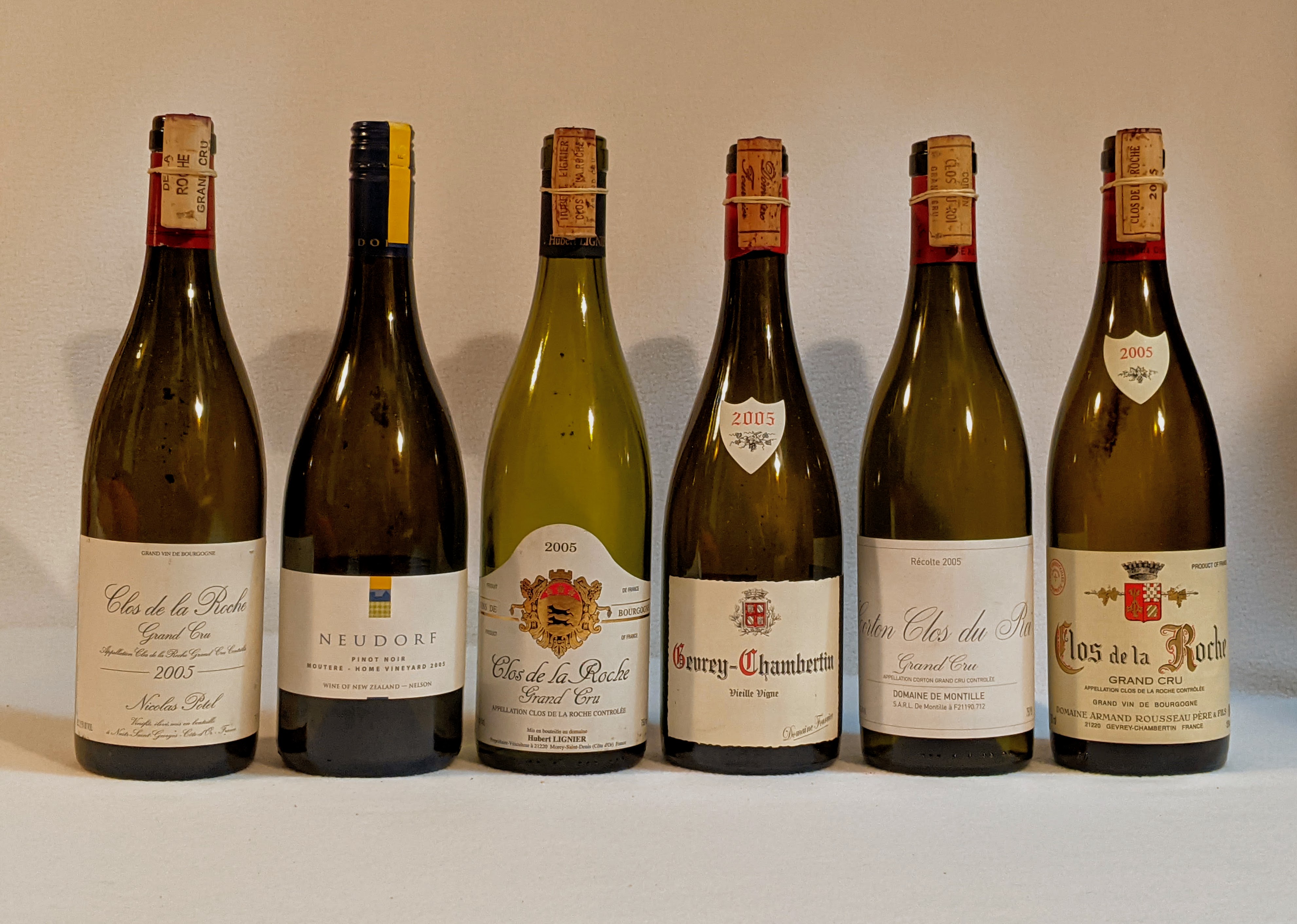
The top six wines of the tasting. From left to right, all three versions of the feature wine in this review, Clos de la Roche Grand Cru, achieved the top six, but the Potel bottling only just … scoring the same 18 rating as Bachelet’s Village Gevrey-Chambertin – always an out-performer. The Potel just had a little more vinosity, at its stage of full development, whereas the Bachelet has years to go. Next came the surprise ranking of the tasting, the sheer quality and typicité shown by the New Zealand Nelson wine, 2005 Neudorf Pinot Noir Moutere Hills Home Vineyard. Not quite the harmony today of the Potel, but much greater potential, 18+. Then the relatively rare Hubert Lignier bottling of Clos de la Roche, a bolder wine and the closest in style to the Neudorf, but riper, 18.5. Then another surprise among the high-achievers, the pale but silky, subtle and nearly-floral Fourrier Gevrey-Chambertin, also ‘merely’ a Village wine, 18.5. My second-favourite wine was a lovely bottle of Domaine de Montille Corton Clos du Roi Grand Cru. This was so understated that no tasters rated it their first or second wine, but it was clearly floral, truly burgundian, and the palate weight / dry extract was of a calibre to remind of great burgundies from earlier years, 18.5+. It would be magical with a subtler meat meal. And then on the right, with a certain air of inevitability, the Rousseau bottling of Clos de la Roche had an understated impression of pure burgundian complexity and elegance that took it up to top place, though it was neither as floral or as rich as an older taster might wish, 19.
As introduced above, the question arose in subsequent discussion: will we ever see again the more conspicuous florality which characterised the better classed burgundies in earlier great vintages such as 1969 and 1971. The general feeling from the longer and more critically experienced tasters was: global warming has made achieving complex florality much more difficult. There is more emphasis on fruit now. Though we noted that the long lurch to ever-greater ripeness as sought by some American wine-writers has passed its zenith … and growers are striving to return to the enhanced complexity that critically-chosen ripeness and a floral dimension so uniquely gives to great pinot noir. We also noted that by and large, rather too many wine-writers in warmer-climate viticultural countries scarcely think about or describe floral complexity: there are exceptions, but its appreciation is very much the reserve of European wine-writers. In this debate, due to its almost unique climatic advantages, New Zealand needs to be constantly thoughtful of the role a floral dimension can play in great pinot noir expression. And in syrah, and riesling and other varieties. We are too much influenced by Australia, in this issue.
On including a New Zealand wine: A key feature of this 2005 Burgundy tasting is the inclusion of 2005 Neudorf Pinot Noir Home Vineyard, to note and honour the life and now (31 Oct 2025) death of Nelson pioneer winemaker Tim Finn (1946-2025). His Neudorf Vineyard has become famous for its Moutere Chardonnays and Moutere Pinot Noirs, even though the winery is a little under the radar … not seeking the lime-light … in Tim’s understated style.
Some wondered how even a well-regarded New Zealand pinot noir would fare, in a field of serious burgundies, seven of them classed growths, plus some very highly-regarded Village wines. The results were quite simply a revelation.
In attending the tasting, participants knew the 12 wines that would be offered. My approach in presenting the wines totally blind, is immediately after decanting, to assess the settling dregs as glass samples, and then strive to arrange the wines in a format that first sets a good representative wine as #1, as a class ‘sighter’, and then arrange the other 11 in a sequence whereby the wines ‘talk’ with each other in a meaningful way, particularly so that no ‘distinctive’ wine impairs the one following it, and to thus (hopefully) reveal the best facets of each sample. Generally this means that lesser, or bolder, or too distinctive wines, are set in the first 6, then the subtler and / or more complex wines in the second six. Though in sequencing them, it is important to not make identification easy … for example the most expensive wine is not necessarily #12 … the goal is to foster examination and discussion of the achievements of each wine for itself, the actual sample, not the guessed label.
To share tasters' skills to best advantage for other participants, once the blind and invariably very quiet evaluation stage of assessing the wines has tapered off, and chatter starts, there is then a short but detailed questionnaire, asking tasters to focus on an assessment of several features for each wine. For this tasting, the six questions for each wine (and hoping that tasters feel they are among friends, and can ‘safely’ express a view on each wine) were:
Is this wine … (from #1 to #12):
• your top-placed wine; • your second-rated wine; • your least wine; and then:
Might this wine be: • a Grand Cru; • from the Cote de Nuits; • from New Zealand.
The results are marked up on a whiteboard, in a matrix for all to see. The goal here is to illuminate how the wine is seen by tasters, the quality and ranking it is thought to have achieved (as a blind sample), as quickly and anonymously as is practicable. Nobody is put on the spot: tasters have to concentrate a good deal to in fact produce meaningful answers. The approach is designed for people who evaluate each wine carefully, irrespective of (the unknown) price: it does not suit label-tasters. Though it must be said: it is fun for tasters wanting to learn, where you have a favourite wine, and you notice a long-experienced-winemaker, or a well-respected wine-judge, also votes that wine their top.
Tasters have a detailed hand-out, as illustrated by the latter parts of this review, with as much winemaking information and qualified opinion (from respected reviewers) as can reasonably be found about each wine.
I give this background to illuminate the context in which the Neudorf wine was seen, and then how it fared. Most importantly, 11 of the 21 tasters thought it a Grand Cru … and thus a French wine. And with four actual Grands Crus known to be in the tasting, a rarity now in New Zealand, participants knew where to set their sights. Only 6 tasters thought it was from New Zealand. Three tasters rated it their top wine of the evening, and one their second-favourite. Nobody rated it their least wine.
This is a wonderfully exciting result both for Neudorf, but even moreso for New Zealand pinot noir in general. Such a result contributes to the informed perception that New Zealand is arguably making some of the best pinot noirs in the world, outside Burgundy. When New Zealand tip-toed into the world of quality pinot noir in 1983, via Danny Schuster’s ground-breaking 1982 St Helena Pinot Noir (review on this website, scroll up two lines) from Canterbury, which won a Gold Medal in the 1983 National Wine Competition, Oregon laid claim to make the finest pinot noirs in the world outside Burgundy. There are now three contenders for such a title: Oregon, Germany consequent on global warming, and New Zealand. In this cross-country comparative discussion, it is important to note that good New Zealand pinot noirs come from microclimates spanning 4 degrees of latitude – an extraordinary state of affairs. They are no one-microsite wonder. With the continuing search for New Zealand sites with calcareous soil parent materials, this is an exciting and ever-evolving story.
Invitation to the 2005 Burgundy Library Tasting:
In this third Library Tasting revisiting the great 2005 vintage in Burgundy, our goal will be to see if the tannins have softened, and the bouquets and general burgundian charms of the wines have increased. But we will also pay tribute to two recently deceased absolute pioneers of pinot noir in New Zealand: the quiet Tim Finn of Neudorf Vineyard, Moutere Hills, Nelson, noted for both chardonnay and pinot noir, and the colourful Danny Schuster of variously Lincoln College Oenology & Viticulture Group, initially St Helena vineyard in Belfast, and later his own Omihi Hills vineyard in northern Waipara, plus overseas consultancies.
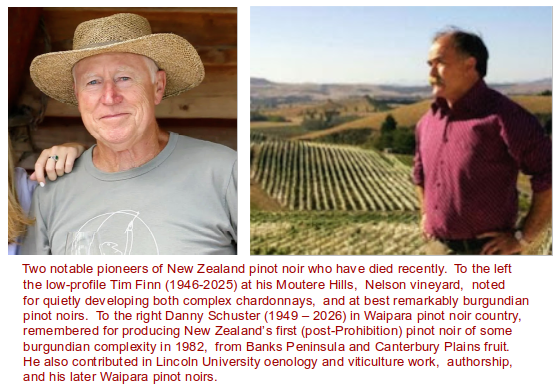
In previous iterations of these 2005 burgundies, I have included New Zealand examples, just to see how we compare (at that stage). To honour Tim, this year the New Zealand wine is his 2005 Pinot Noir Home Vineyard.
For most New Zealanders, even including winemakers, opportunities to taste Grand Cru burgundies are now rare. Few are imported, and even fewer reach retail shelves. This tasting is unmatched in recent-years New Zealand-wide semi-public wine tasting offerings, in providing the chance to compare three different versions of one of the most definitive pinot noir vineyards in all Burgundy, the 16.8 ha Grand Cru Clos de la Roche in Morey-Saint-Denis. Two of our producers are world-famous, Domaine Rousseau and Domaine Hubert Lignier (as may be inferred from the Wine-Searcher current value indications below), and the third Nicolas Potel (ss) is reasonably well-regarded.
As further noted below, a more general issue relevant to informed wine tasting and assessment these days is marking. Points inflation is now endemic in the New World, with both New Zealand and Australian wine-writers now routinely (and tiresomely) scoring local and all-too-often commercial pinot noirs in the middle 90s. Yet upon tasting the wine, all too often the comments suggest the writers have barely if ever tasted Grand Cru burgundy. This tasting will I hope provide a not-easily-matched and valid reference point to tune-up on the qualities of truly fine pinot noir. See Goode 2017, and 2018, for an informed review of this major issue.
The 2005 vintage in burgundy was at the time received with rapturous enthusiasm. Jasper Morris, MW, in the now 'standard text' Inside Burgundy (pp. 623, 624): "For years I used to discuss the potential of a good new red burgundy vintage with Dominique Lafon, and we would say 'yes, that's good, but not as good as 1978'. However there was no such question over 2005 – clearly of greater potential than 1978 or anything else since – or indeed any vintage for many years before. Possibly 1959? The reds will be magnificent over the long term."
Likewise Jancis Robinson, not noted for being easily carried away with the latest fad, reported in 2007: "If there is one dominant characteristic of these wines it is their thrilling combination of ripeness and acidity. ... Fred Mugnier of Domaine J F Mugnier, sees a contradiction in the 2005s because they have both the freshness of a cool vintage and the richness and texture more reminiscent of an overripe vintage. ‘This makes the wines very interesting,’ he assured me, 'because they have great current appeal but also real potential for ageing'."
Evocative stuff. But in an age inclining more to instant gratification ... many have subsequently expressed disquiet at the high tannin levels of these ripe grapes, and found the wines thus far relatively unrewarding. But in general … the top levels of the British wine trade still believe in them.
In my earlier two reviews of the 2005 Burgundies so far, first Otago, then Marlborough and Nelson (with Tim Finn attending the latter), we did feel that maybe the more tender sides of great burgundy ... in particular the floral attributes fine burgundy bouquets can display ... were not thus far too apparent. Whereas the tannin richness and fruit ripeness were. Hence the delay of 10 years in now presenting a third chance to taste these now-rare wines.
In selecting the wines, apart from the benchmarking opportunity noted above, I have sought to show some of the more softly-styled and tending red-fruited Cote de Beaune wines, as well as the ideally more piquant, exciting and hinting-at-darker-fruits wines from the Cote de Nuits. Both groups include a span of classification and price, from Village wines to Grands Crus. No space for a simple Bourgogne !
[ The wines to be offered were then listed, together with Wine-Searcher valuations, noting that there were duplicate bottles for the critical three Clos de la Roche wines, and alternative bottles for the others. This all appears below.]
Information provided at the tasting:
This was in two parts, an Introduction here rearranged and amended, and then a schedule of the 12 wines to be tasted, with considerable detail for each wine. In this report, all that background for the wines is now combined with the tasting review for each wine, presented in rank order below.
Some earlier views on the 2005 vintage in Burgundy:
The view of Jasper Morris, MW, 2010, in the now 'standard text' Inside Burgundy (pp.623, 624) has been recorded above. Earlier in January 2007 he had said to the annual ‘Burgundy Week’ assembly in London: “This is the most uniformly successful vintage I have seen in my career."
Jancis Robinson, MW, various dates: “As in Bordeaux, a quite exceptionally good vintage, although many wines may go through a prolonged stage of chewy adolescence."
Farr Vintners, London, various dates: “One of the great, if perhaps atypical, Burgundy vintages. The wines are dense, powerful and ripe. Village level wines and Premiers Crus are now drinking well, though the top wines can still be stubborn and may warrant further ageing."
Decanter, London, various dates: “Sumptuous and generous styles of wine that will make fantastic drinking in the coming years. Ripe yet still fresh ... A characteristic of this year’s Pinot Noir is the thickness of its skins – a pointer to colour and structure in the wines. Best Appellations: Uniformly good. Rating 5/5."
David Schildknecht @ Wine Advocate, 2007, (précis): “Two thousand five is one of Burgundy’s great red wine vintages ... a vintage of unprecedented quality ... The personality of wines from this luminous, gloriously healthy and ripe vintage is ... decidedly on the dark side of the flavor spectrum. ... Many of the best Pinots of 2005 push the limit of ripeness consistent with freshness, and the limit of sheer density consistent with elegance. Firm, fine tannins are never far from the surface .... These wines will need time in the bottle to show their true colors, and most of them should be expected to shut down for an extended period soon after bottling."
And Allen Meadows, who by now must have tasted more burgundies than any living person (surely ?) likewise said in 2007: “2005 is quite simply the best top to bottom vintage that I have ever seen … “. He went on to say: “The best 2005s from the Cote de Beaune are quite simply sublime burgundies that will be capable of exceptional longevity with 20 years being a given. As in the Cote de Nuits, it seems that each level of the Burgundian hierarchy transcends its usual quality category and ascends to the one directly above, which is to say that regional wines perform like villages wines, villages wines like good if not absolute top 1ers, good 1ers are like solid grands crus and the best examples of Corton grands crus are among the best that I have ever seen."
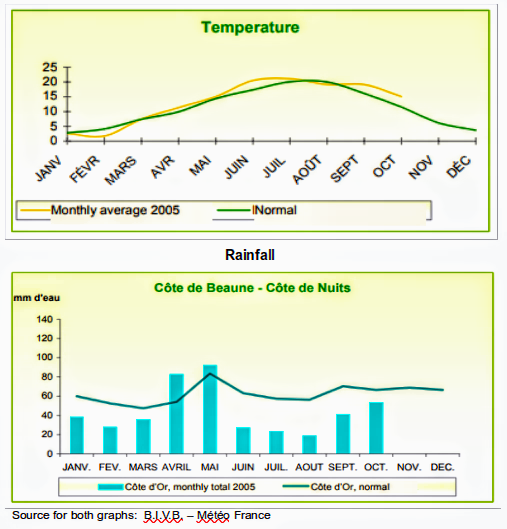
The Weather: Temperature and Rainfall for the 2005 vintage in Burgundy:
The standing of the 2005 burgundies in 2026:
Since the early comments noted above, as the wines gradually reached the market, quite a few tasters have expressed doubts about the tannin levels in the wines. Would the bouquets and palates expand, and would the tannins soften ?
In 2026, a quick sampling of the Net suggests that the most experienced authors are still positive about most of the 2005s. The nay-sayers are quick to write about wines that have disappointed them … as if every last wine made that year should be revelatory. No matter what the year, there are always winemakers who slip up in that particular vintage.
But overall, there are surprisingly few recent reviews of any number of the 2005 burgundies. In 2025 Jasper Morris undertook a review of 21 of the reds, but the report is behind a pay-wall. Such snippets as reach the Net report that Morris’s early faith in the vintage is justified. He notes that some of the more affordable wines show the dry tanniny side of the vintage, but for wines of reputation, and especially in the Côte de Nuits, there are many “superb wines" … “fully living up to the early hype". And further, “There is still a lot of life left in the best examples.".
Jancis Robinson's website unfortunately does not have an effective search function (for articles), so I cannot find if she has made any recent systematic review of the 2005s. Since burgundy is very much a wine in the style her subtle palate approves of, I have tried to include any of her recent tasting notes in the introductions to our wines in the list below. She did review 64 examples in August 2015, and at that 10-year point, after an introductory comment: “The 2005 red burgundies are rightly revered", she felt many Cote de Beaune wines were then approachable, whereas the Cote de Nuits needed time. She concluded her article with the observation: “All in all, I am just as enthused about 2005 red burgundies as I am about 2005 red bordeaux …".
The Net does include many comments from enthusiast wine-groups such as ‘Wine Berserkers’ on the 2005s, but one does not need to have attended too many meetings of such groups, to know how wildly disparate the views of members are.
All in all, to a quick sampling of the Net, I came to the conclusion that our review will be even more interesting than I anticipated, and even more timely, at the 21-years-on point.
References:
Since preparing the 2015 and 2016 handouts, there is now a good deal more wine-reviewer info accessible on the Net, via the websites of such switched-on firms as K & L wine merchants, based in California, plus the ever-dependable Farr Vintners, London.
Goode, Jamie 2018: Should wine scores be absolute ? www.wineanorak.com/wineblog/uncategorized/should-wine-scores-be-absolute
Goode, Jamie 2017: Score inflation is everywhere and it's killing wine criticism
https://www.wineanorak.com/wineblog/uncategorized/score-inflation-is-everywhere-and-its-killing-wine-criticism
Morris, Jasper 2010: Inside Burgundy: The vineyards, the wine and the people. Berry Bros & Rudd Press, 656 p.
Norman, Remington & Charles Taylor, 2010: The Great Domaines of Burgundy Sterling, 288 p.
Robinson, Jancis, 2015: Keeping cool with 2005 burgundies (free access) https://www.jancisrobinson.com/articles/keeping-cool-with-2005-burgundies
Schildknecht, David 2007: Burgundy 2005: The Dark Beauties of a Luminous Vintage - Part 1: https://www.robertparker.com/articles/TyhtPgTT3E5ZxTbir, Subscription only.
www.burghound.com = Allen Meadows, Subscription only.
https://insideburgundy.com = Jasper Morris website, some introductory and overview material available, wine reviews Subscription only.
https://wineanorak.com Jamie Goode, PhD (in plant science), UK author of Wine Anorak, a 'global wine journal' on-line. Free access.
www.jancisrobinson.com = Jancis Robinson and associates, some introductory and overview material available, wine reviews Subscription only.
www.robertparker.com = Robert Parker now in name only, for this tasting David Schildknecht, Subscription only.
www.bourgogne-wines.com/press/gallery_files/site/289/1910/37750.pdf = weather
https://weather-and-climate.com/average-monthly-min-max-Temperature,beaune,France = temperature
Acknowledgements:
Scott Gray of Maison-Vauron kindly assisted with access to key information. John Kavanagh, now at Foley Cellars, Martinborough, was the winemaker for the 2005 Neudorf Moutere wine, and added wine-making detail, plus attending the tasting. Kevin Courtney from Riverby Estate, Marlborough, also attended the tasting, and subsequently made further much-appreciated information available. John Shearlock of Regional Wines facilitated the Library Tasting in that firm’s tasting room, and printed and assembled the handout and placemat. And John Comerford kindly made the 2005 Potel Clos de la Roche available, enabling us to have three versions of this highly-ranked vineyard.
THE WINES REVIEWED:
The Wines: There was a duplicate bottle for each of the all-important Clos de la Roche wines, only. Otherwise there were other reserve bottles. The price indications below for the French wines are current values, from Wine-Searcher. The search for background info for the wine-notes started with Morris, 2010 … but it lacks the detail we need. Searching and sifting the publications noted under References followed, plus the Net generally. All wines were bought at initial release, and have been cellared in Wellington since original purchase.
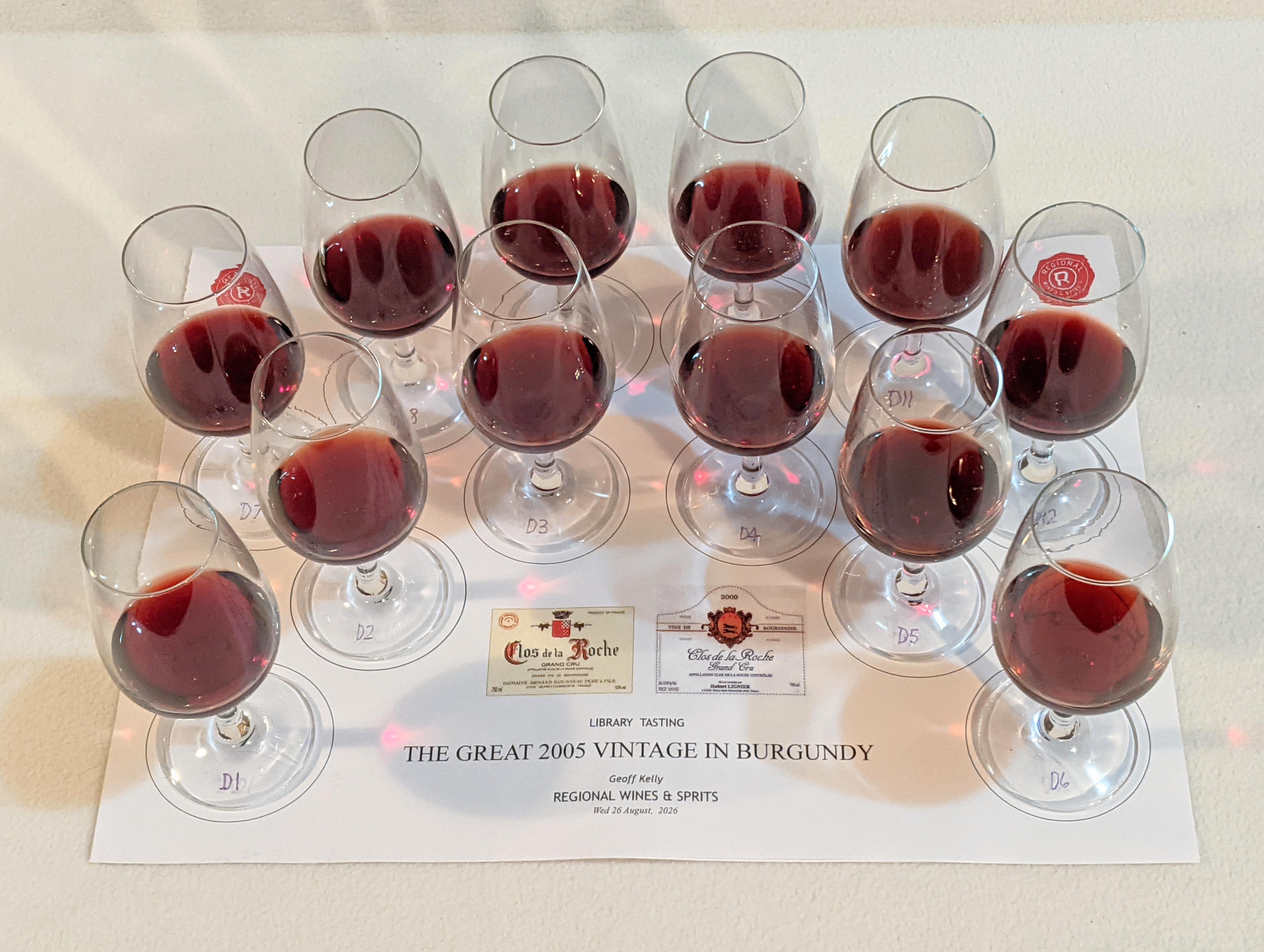
Once the wines were poured, this was the pleasantly fragrant sight that greeted tasters. There is not quite the transparency in a photo, but wine 2, the Bouchard Beaune-Greves (which turned out to be somewhat oxidised) is the palest wine, contrasting with the oaky Bocquenet Nuits-Saint-Georges at place 5 as the darkest wine. The Grivot Vosne-Romanée at position 1, the Potel Volnay Vieilles Vignes at place 3, and the Rousseau Clos de la Roche at place 10, represent the middle range of typical burgundy colours, at the 20-year point in a good vintage. The Corton Clos du Roi at position 6 is of particular interest, being the second-palest wine, yet it was truly fragrant, and likely contains the greatest dry extract in the set. Truly burgundian. And the New World challenger, Neudorf Home Paddock at position 8, the second deepest wine, still shows the youthful vigour that Jancis Robinson commented on in 2008, noting that it was a much more serious pinot noir than most New Zealand examples. The sequence of wines (all 2005s) is, from front left, row 1, position 1 to back right, row 2, position 12, is : 1 = Grivot Vosne-Romanée Les Rouges Premier Cru, 17.5+; 2 = Bouchard Beaune-Greves Premier Cru, 14; 3 = Potel Volnay Vieilles Vignes, 16; 4 = Montille Pommard Les Rugiens Premier Cru, 17.5; 5 = Bocquenet Nuits-Saint-Georges aux Saint-Julien, 17+; 6 = Montille Corton Clos du Roi Grand Cru, 18.5+; 7 = Bachelet Gevrey-Chambertin Vieilles Vignes, 18; 8 = Neudorf Moutere Home Paddock, 18+; 9 = Potel Clos de la Roche Grand Cru, 18; 10 = Rousseau Clos de la Roche Grand Cru, 19; 11 = Fourrier Gevrey-Chambertin Vieille Vigne, 18.5, and wine 12 is the Hubert Lignier Clos de la Roche Grand Cru, 18.5. In aiming for the sequence of wines to best reflect the qualities of each wine, and optimise each, no two people would arrange them the same. The general feeling among tasters was the above sequence worked well.
Scoring: As introduced above, in conducting tastings, I have little patience with the points inflation now so bedevilling wine evaluation in the New World, and so enslaving unthinking wine judges. Wine Shows started with the goal of ‘improving the breed’ … as per their agricultural origins. No longer. In New Zealand and Britain at least they are now dominated by certain much-trumpeted and frankly commercial groupings. The result will be the complete devaluation and discrediting of panel-style wine judging results, irrespective of wine-judges’ sincerity, goals or credentials. The scoring below retains the traditional 18.5 points threshold for gold medal ranking.
The first price shown below for each wine is the current Wine-Searcher value. Where known, an approximate price at release is included in the text. The wines are listed in rank order. This ranking is a personal view, though to a degree guided by the pattern of voting by participants in the tasting.

A lovely limpid medium ruby, garnet scarcely detectable, a perfect burgundy colour at 20 years age, just below midway in depth. The bouquet on this wine stands out for its understated perfection as red burgundy, classic fragrant red cherry hinting only at black cherry fruit, a little Cote de Nuits zing and uplift, cedary oak of exquisite subtlety. Alcohol seems as stated. Palate shows a little more oak than the bouquet, red cherry and red plum, beautiful acid balance, medium length. Not a big wine, but fragrant, shapely and supremely elegant. At an early peak now, and with 15 years or so to come. Six tasters rated this as their top wine, and eight as their second-favourite. It was recognised as a Grand Cru and Cote de Nuits wine by all those participating in the ranking ... say 16 of the 21 tasters. No-one thought it from New Zealand. Note this wine was in Morris’s 2025 review, as above. GK 08/26
An even more limpid and lighter ruby than the Rousseau, hints of garnet creeping into the ruby, the second lightest wine. There has never been any correlation between depth of colour, and quality of wine, in red burgundy. The softly fragrant bouquet shows more emphasis on red cherry fruit, with beautiful oak a little more noticeable than the Rousseau. Alcohol seems as stated. The wine really gains points on palate, wonderful richness and texture, fractionally the richest in the tasting. That does not mean it is the biggest wine: the magic of good dry extract values is this saturation of flavour and fruit on the palate, the suggestion of layers of fruit which outweigh the oak. This is a splendid Cotes de Beaune, ranking with the best Cote de Nuits wines in this set. Beautifully mature now, but still with some years in hand. This was the unsung wine of the tasting, nobody ranking it top or second, all but one recognising it as Cotes de Beaune, three wondering if it might be New Zealand. Living next to a much warmer-climate wine country as we do, it is all too easy to forget that most wines that are highly-acclaimed in Europe are about beauty of bouquet and length on palate, not weight and impact. Nowhere does this apply more than in red burgundy. GK 08/26
Garnet more than ruby, a similar weight and limpidity to the Corton Grand Cru, the third-lightest wine. Bouquet reveals much of the charm tasters seek in fine burgundy, a wonderful softness and implicit florality reminiscent of (for this wine) salmon-pink rose flowers, leading to all red cherry fruit which though light in berry character, smells surprisingly rich. Alcohol seems as stated. Just on bouquet, your hope is this wine will have the texture in mouth to match the other pale but rich wine, the Corton. On tasting, not quite, but the length is still very good. This really is a Grand Cru wine hiding in a Village label … quite remarkable. You can easily imagine a delicate yet sustained wine like this being dismissed in hotter-climate wine countries seeking more heroic wines – but for Wellington pinotphiles it sang: 10 top places, four second-favourites, 17 thought it a Grand Cru, and (surprisingly) 14 identified it as Cote de Nuits. One of the surprises in the tasting. No-one thought it from New Zealand. GK 08/26
The wine colour still much more ruby than garnet, the third-deepest wine in the tasting with still quite a dark centre, lovely. This is altogether a bigger bouquet, wonderful black more than red cherry fruit with an exciting Cote de Nuits zing and uplift, hints of dark plums and even blackcurrant / cassis, I reluctantly concede. Cedary oak is well matched to the exciting berryfruit. Alcohol seems a little higher than stated. In mouth there is a big tanniny berry flavour, even a hint of sun shining on blackberries, again not quite typical fine burgundy, a bold wine with nearly the beguiling length of palate and dry extract as the top two. As Harry Waugh used to say, there are still tannins to lose here. I imagine in another 10 years this wine may well rank more highly. It sat next to a very delicate wine, which may have disadvantaged it a little. Rated top wine by one taster, clearly a Grand Cru wine by 14 tasters, and a Cote de Nuits wine by nearly as many. Has many years ahead of it, say 20. In style the closest of the burgundies to the Neudorf wine, but it is conspicuously riper and with gentler acid and tannin. No-one thought it from New Zealand. GK 08/26
Ruby more than garnet, the second deepest wine in the tasting. Quite a big bouquet, a lot of vibrant red and black cherry and berry, alongside the Bachelet the fruit not quite so ripe though in a subtle way, and the oak a little more noticeable and cedary. Great purity. Alcohol close to that stated. Flavour is bold, clear red and black cherry, the total acid a little higher than the better burgundies, with the acid making the oak more noticeable. The whole wine is extremely fresh and vital, as young as any on the table. Dry extract is good but not exemplary, as in the Corton or Rousseau. In this tasting including four Grands Crus wines, the view tasters formed of this wine at the blind stage could not be more exciting. Three tasters rated it the top wine of the evening, and one their second-favourite. More importantly however, 11 tasters thought this a Grand Cru wine … and therefore French. Six astute tasters sussed it was from New Zealand, perhaps working on the clues outlined above. Two thought there is a hint of stalkiness. For this wine to be thought a Grand Cru in a tasting of this calibre is truly exciting for both the New Zealand wine industry, and more particularly for pinot noir growers – to say nothing of the pleasure for the Neudorf winery people. To have the maker of the wine among the tasters only increased the general appreciation of it. And the excitement only increases when the clues to even greater quality can be seen in the glass: a little more fruit ripeness in the vineyard, and thus lower acid, and a little less new oak in the winery. In its way, a revelation. Will cellar another 15 years or so. A pity so many New Zealand wine people drink such wines far too young. Nowadays, only the most everyday New Zealand red does not improve for 10 years. GK 08/26
A youthful velvety ruby, the freshest colour on the table, a perfect colour for a darker burgundy. Bouquet is velvety too, with hints of the deepest darkest red roses, and all black cherry fruit grading to dark plum, plus suggestions of that magic smell of blackberries in the sun – unusual for pinot noir. Alcohol seems a little above that stated. Palate is plump, no other word for it, black cherry again and lots of it, not the subtlety, complexity and length of the Rousseau, nor the refined oak, but beautiful oak handling and a remarkable introduction to pinot noir from Cote de Nuits. Just a hint fleshy, alongside the Potel Clos de la Roche. This wine simply could not be a Cote de Beaune. Placed alongside the Neudorf, to permit examination of their differing acid balances, ripeness, and oak handling. No top places, but two tasters rated it their second favourite, four thought it Cote de Nuits, and three thought New Zealand. I find Jasper Morris had this wine in his ‘Twenty Years On’ review, last year. He commented: “A glowing glossy red … youthful red fruit. Very firm and tannic on the palate, though still with an intensity of fruit … to 2040, 91." Will cellar for 10 – 15 years plus. GK 08/26
A shining ruby and garnet, in the middle for depth. A bouquet of great purity, a little bit floral in the light red rose spectrum, all red cherry fruit including even a hint of pomegranate, very subtle oak indeed. Alcohol close to that stated. Palate is a little shorter and drier than the bouquet promises, clear red cherry, reasonable length, not quite the excitement or body of the other two examples of Clos de la Roche. But how wonderful to have three together. Acid balance is perfect. Nobody rated the Potel version their top wine, three had it as their second-favourite, two thought it a Grand Cru wine, but only one a Cote de Nuits – interesting. There is just a little more vinosity than the Bachelet, though they are scored the same. It is shorter and drier than the Corton Grand Cru – you can see why it was interpreted as a Cotes de Beaune wine. Fully mature now, not so much one for the longer haul. No-one thought it from New Zealand. GK 08/26
Ruby and garnet, bright and attractive, right in the middle for depth of colour. Bouquet is pleasingly complex, a clear red floral component, a lot of red and some darker cherry, subtle oak, and hints of the piquant zing that points to the Cote de Nuits. [ By ‘zing’ here and elsewhere I refer to terpene-like aromatics and bouquet excitement, not VA.] Alcohol seems a little more than stated. In mouth the flavours darken a little to more black cherry, the oak and acid balances are exemplary, all factors pointing to a quality classed growth. It does not have the palate weight of the Bachelet for example, and the acid balance is a little crisper. Because it so typified good burgundy, without being benchmark in any dimension, it seemed the perfect wine to place as number one, to act as the ‘sighter’ wine for the tasting. As such, the first wine rarely gets a fair assessment … and so it proved. This wine received no rankings at all. Nonetheless it is good burgundy, approaching full maturity, and nicely balanced. It will cellar another 5 – 10 years. GK 08/26
Ruby and garnet, in the middle of the field for depth. This wine is further along its development path than most on the table, showing attractively fragrant but not quite floral all red fruits browning a little now, with pleasantly subtle oak. Alcohol seems close to that stated. Palate is straightforward maturing red-cherry Cote de Beaune, not a rich wine but attractively balanced to the soft oak, showing some length. At a peak for drinking now and in the next few years. People liked the approachability of this wine, one top rating, two second-favourite. One thought it a Grand Cru, and five thought it Cote de Nuits, perhaps on the oak aromatics. Three thought it could be New Zealand … again hinting at how far down the track towards Burgundy complexity good New Zealand pinot noir can be. GK 08/26
Ruby, garnet and velvet, tending deep for burgundy, the deepest wine on the table. And a big bouquet, tending aromatic and New World in style, in the sense that oak is very noticeable, along with big dark berry. Fruit character is more overtly plummy than dark cherry, and the wine is very aromatic on the oak. Alcohol is close to that stated. Flavour is as bold as the bouquet, again New World suggestions, oak flavours more noticeable than the kind of berry. But as the colour suggests, it is a rich wine. Though the colour is tending older, this is likely because of the oak handling, so it seems a wine to put aside for 10 years, in the hope that it loses some tannin via polymerisation. Many in the New World would like this wine, for exactly the reasons stated, but it lacks burgundian subtlety and charm, as yet. Two people rated it their second-favourite wine, one thought it Cote de Nuits, otherwise comment was lacking. Cellar another 10 – 15 years, to soften, and perhaps longer, colour notwithstanding. GK 08/26
Ruby and garnet, bright, just below the middle for depth. We had to have a Volnay in the tasting, though it might seem a bit small and fading in the company, to honour the second New Zealand pinot noir pioneer who has died recently. As noted above, Danny Schuster (1949 – 2026, died 29 July 2026) was New Zealand's first producer of quality pinot noir since Prohibition. (Though the at-best-lovely Mission Estate Reserve Pinot of the '50s and '60s, said by Ian Clark to be based on pinot meuniere, as it was then called, should be remembered. And Babich and Nobilo in Auckland later had forms of pinot noir, possibly the Swiss bachtobel clone.) Danny convened many wine gatherings over the years, and loved talking about burgundies. He would often say, if you want to learn about burgundy, start with Volnay. This comment of his reveals one of the endearing sides of Danny's personality. In his life, there were very few geese, and many swans. And this wine made that point well enough: clean and lightly fragrant / floral all red cherry aromas, browning a little now with age. Alcohol is close to that stated. Palate is a little older, clean but older oak, the fruit shortening now and starting to dry, a little acid peeping through, the oak in balance. On closer examination, just traces of age-related deterioration. This wine should be finished up in the next year or two, while it still has fading fruit. Six rated it their least wine, and two thought it from New Zealand. GK 08/26
Garnet more than ruby, the oldest wine on the table, the lightest wine though still a good old burgundy colour. Alcohol seems a little higher than that stated. By the time of the presentation, several hours after decanting, and 22 km away, this wine was showing biscuitty characters in faded red fruit, with hints of Bovril oxidation / complexity factors. Still pleasant in its way, but out of condition / tired. The cork appeared to be perfect, the ullage was minimal at 11 mm, so … sadly … this wine is yet another victim of premature oxidation under cork. The palate still has good red cherry physical fruit, but in this bottle browning unduly now, and noticeable body, and the oak handling is good. It was the least wine for 11 tasters. It is still perfectly pleasant in a savoury way … and with suitable food … though it would not please burgundy aficionados. It has had good reviews elsewhere recently, notably from Jasper Morris in his review of some 2005 red burgundies last year, where he described it as: “a high-class bouquet … The fruit builds really beautifully on the palate, filling out the mouth with no rough tannins. Exemplary, to 2035, 95". Makes you sorry to have missed it, with our unlucky bottle. GK 08/26
© Geoff Kelly. By using this site you agree to the Terms of Use. Please advise me of errors.